
THE TIMES OF ISRAEL
By Rossella Tercatin
Rothschild Vienna Mahzor, completed five years before community’s destruction, going under hammer after being returned to heirs in 2023; expected to sell for $5-7 million
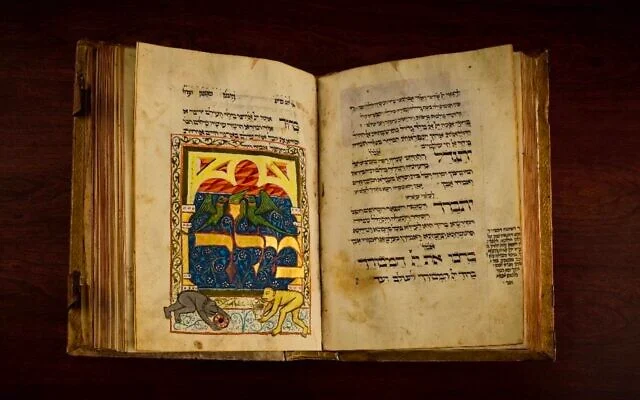
A rare 15th-century illustrated High Holidays prayer book, which witnessed some of the most dramatic chapters of European Jewish history, is expected to fetch up to $7 million when it goes up for auction on Thursday in New York, the Sotheby’s auction house said.
The volume, known as the Rothschild Vienna Mahzor, is expected to be among the most expensive Hebrew manuscripts ever sold at auction, reflecting both its extraordinary illustrations and historical importance.
Completed in Vienna in 1415, the tome was bought by the Rothschild family in the 19th century and confiscated by the Nazis after they annexed Austria in 1938. It remained in the Austrian National Library for decades before being returned to the heirs of its owners in 2023.
Sotheby’s)
A rare 15th-century illustrated High Holidays prayer book, which witnessed some of the most dramatic chapters of European Jewish history, is expected to fetch up to $7 million when it goes up for auction on Thursday in New York, the Sotheby’s auction house said.
The volume, known as the Rothschild Vienna Mahzor, is expected to be among the most expensive Hebrew manuscripts ever sold at auction, reflecting both its extraordinary illustrations and historical importance.
Completed in Vienna in 1415, the tome was bought by the Rothschild family in the 19th century and confiscated by the Nazis after they annexed Austria in 1938. It remained in the Austrian National Library for decades before being returned to the heirs of its owners in 2023.
The prayer book features still-striking mineral-based colors, such as deep lapis blues, verdant copper greens, and cinnabar reds, as well as burnished gold initial-word panels.
The illustrations include fantastical human and animal-like figures rendered in Gothic style. In light of its significant size and sophistication, experts have identified it as a mahzor, or holiday prayer book, used by a cantor in the middle of the synagogue to lead communal prayers during Rosh Hashanah and Yom Kippur services.
It was created at a time when Vienna and much of the rest of Europe was still recovering from the bubonic plague that had wiped out up to half the Continent some 65 years earlier, and just a few years before the city’s Jewish community was ordered by Vienna’s Hapsburg rulers to be killed or driven out.
“What makes this mahzor truly rare is not only its beauty, but its historical position,” Chaim Neria, curator of the Haim and Hanna Solomon Judaica Collection at the National Library of Israel, told The Times of Israel in a message. “Almost no illuminated Ashkenazi mahzorim survive from the decades following the devastation of the Black Death.”
“Even more poignantly, the manuscript preserves the liturgical customs of the Jewish community of Vienna just a few years before that community was effectively destroyed in the Vienna persecutions of 1420–1421,” he added. “In this sense, it is not only a beautiful object, but a rare surviving witness to a silenced world.”
The name of the scribe, Moses son of Menachem, is included in the mahzor.
“The scribe, Moses, the son of Menachem, was extremely skilled, and it probably took him the better part of a year to write over 202 folios, that is, about 400 pages of beautifully inscribed text,” Sharon Liberman Mintz, Sotheby’s Judaica international senior specialist, said in a video presentation.
Experts do not know what happened to the book after the Vienna community was decimated and expelled.
It resurfaced over 400 years later, in Nuremberg, Germany, when Salomon Mayer von Rothschild, the founder of the Vienna branch of the prominent Jewish banking family, purchased the book for his son Anselm Salomon von Rothschild in 1842.
Passed through the generations, it was looted from the Rothschild Palais in Vienna by the Nazis, together with all the other contents of the residence, including artwork and books.
A portion of the holdings were brought to the Austrian National Library, where it was neither inventoried nor marked as confiscated, and it remained there for decades. After years of research, scholars correctly identified the book as belonging to the Rothschild family at the end of the 1990s.
It remained in the library’s hands, though it was loaned to the Jewish Museum of Vienna in 2021 and presented to the public for the first time.
Only in 2023, following a recommendation by the Austrian Art Restitution Advisory Board, was it returned to the heirs of the last owners, Alphonse and Clarice von Rothschild, who were in England at the time the Nazis looted their home and stripped them of their properties.
“While the wrongs of the past can never be undone, the restitution of this mahzor carries deep meaning for our family as it stands as both an acknowledgment of history and a small measure of closure to a pain that has echoed through generations,” the heirs said in a statement disseminated by Sotheby’s.
According to Mintz, the book “stands not only as a masterpiece of medieval illumination but also as a symbol of extraordinary historical perseverance. Its six-century journey mirrors the broader story of Jewish resilience.”
The auction house said it expects the mahzor to be sold for $5 million to $7 million when it goes under the hammer.
In 2021, another medieval illustrated prayer book, the Luzzatto High Holiday Mahzor, was sold to an unnamed private buyer for $8.3 million, easily beating Sotheby’s pre-sale estimate of $4-6 million and marking the record for an illustrated Hebrew manuscript. A 16th-century Talmud sold in 2015 brought in $9 million at auction, a record for a piece of Judaica.
Neria expressed hopes that the buyer would donate the volume to a museum or other collection rather than keep it for themselves.
“From my perspective, this is not merely an object of beauty or scholarship; it is a fragile but eloquent voice from Jewish history, one that deserves to be preserved, studied, and made accessible to the public in the most responsible institutional home,” Neria said. “I do hope that there will be a way in which this mahzor will return to the hands of the Jewish people at large and not just hidden in a private collection.”