
Jerusalem Post
ByJOSHUA HALICKMAN
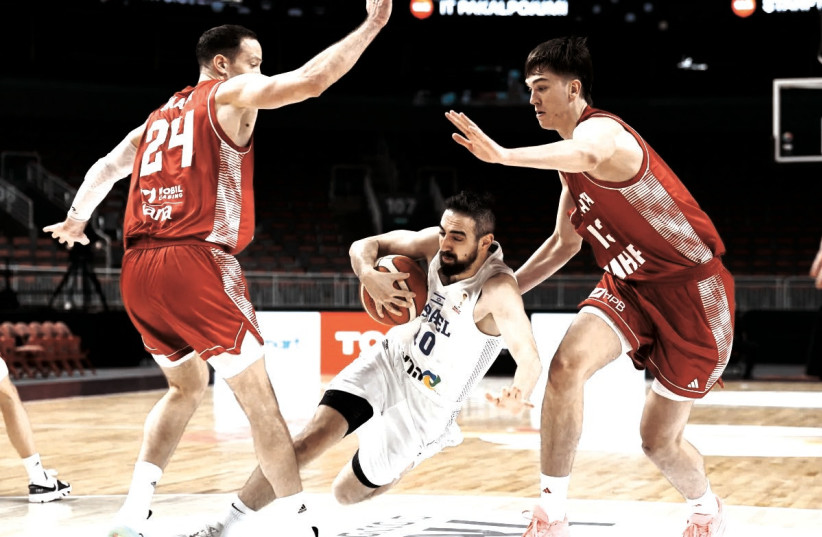
Playing the “home” game in Riga is obviously not ideal for Israel, but the squad has faced this challenge since the outbreak of the war in October 2023.
There are simply too many adjectives to describe how the Israel Men’s National Basketball Team performed in the first window of 2027 World Cup Qualifiers, and none of them are flattering, to say the least.
Head coach Ariel Beit Halachmi’s team looked like a shadow of the squad that competed in this summer’s EuroBasket, primarily because Deni Avdija and Yam Madar were unavailable for the games in Germany and against Croatia. The absence of these two key players, of course, was significant, but it hardly explains the sheer lack of cohesion, effort, and execution that characterized Israel’s performances in both contests.
To describe the blue-and-white’s showing as bad, brutal, awful, terrible, pathetic, or embarrassing would not do justice. They were an absolute disgrace.
It’s one thing to lose by 20 points to Germany, the past World and European champions, who have a deep roster filled with talent, experience, and NBA-level athletes. That kind of defeat is understandable. But it’s another to come out against Croatia and appear completely unprepared, falling behind 12-0 in under three minutes, a deficit that set the tone for the rest of the match. From that point on, Israel seemed incapable of finding any rhythm, any sense of organization, or any sort of plan to compete effectively.
Israel had no flow, no clear ideas, and no coherent game plan. Defense, normally a cornerstone of any competitive squad, was largely absent. Plain and simple, Beit Halachmi did not prepare his squad well enough to even attempt to compete against these two opponents. From top to bottom, the blue-and-white were a disaster, with players looking as if they would rather watch paint dry than represent their country with any sense of pride or urgency.
These are harsh words, but anyone who watched the games would wholeheartedly agree. The coach had no discernible impact on his players during the matches, and there were no effective adjustments or solutions in the second half against Croatia, a period the team will surely want to erase from memory as quickly as possible.
There were plenty of newcomers and players who did not participate in EuroBasket, including Gur Lavi, Lior Carreira, Yair Kravits, Tamir Blatt, Idan Zalmanson, Netanel Artzi, and Roi Huber. Naturally, the lack of experience and chemistry could partially explain Israel’s poor performance. But veteran players such as Yovel Zoosman, Khadeen Carrington, Itay Segev, Bar Timor, and Roman Sorkin, who was really the only player to deliver a solid performance, should have done far more. Experience, leadership, and effort were all in short supply.
With a roster that included eight Euroleague and EuroCup players, Israel had to perform better. There are no excuses. Mario Hezonja was the Croatian star, and after dominating Hapoel Tel Aviv with Real Madrid last week, he repeated the feat against Israel alongside Michael Ruzic.
The statistics from the loss to Croatia are telling and illustrate the story perfectly: rebounds, 38-27 for Croatia; assists, 29-18 for Croatia. Two-point field goals? 25-of-35 (71.4%) for Croatia to 20-of-41 (48.8%) for Israel. How does a team allow such a disparity? How do players allow themselves to be out-rebounded, out-assisted, and outshot across nearly every category? The stats tell a brutal story.
The numbers from the Germany defeat were similarly bleak. There is no hiding behind statistics, they always tell the truth, and the truth is that Israel was beaten in nearly every conceivable way in these two losses. Beit Halachmi stated in postgame comments that he did not want to make excuses but that the team had very little time to practice. That is an excuse. Every team faced similar scheduling and preparation challenges. Israel simply failed to rise to the occasion.
Playing the “home” game in Riga is obviously not ideal for Israel, but the squad has faced this challenge since the outbreak of the war in October 2023. This is not new; the coach, staff, and most players have already experienced it.
This is professional basketball, not an amateur competition. Teams must adapt, focus, and find ways to compete regardless of circumstances.
Damage from the opening window has 'already been done'
When Israel reconvenes in February 2026, they will finally have a true home-and-home series against Cyprus, likely resulting in two wins. However, the damage from this opening window has already been done for this World Cup campaign, and Israel now faces a significantly tougher road ahead.
After that, Israel will face Croatia and Germany once more in July 2026. This is a window in which NBA players such as Deni Avdija, Ben Saraf, and Danny Wolf could theoretically join the squad. But it remains unclear whether their respective teams will grant permission, and NBA players will also be available to Germany and Croatia. This means Israel could still face strong opposition even with additional reinforcements.
In the four-team World Cup qualifying group, the top three teams advance to the second round, and Israel will almost certainly be one of them. The problem is that records carry over, and Israel’s Group E will merge with Group F, which includes Poland, Latvia, the Netherlands, and Austria. From there, the top three teams advance to Qatar.
Another window of games occurs at the end of August, again potentially allowing NBA players to participate – if their teams grant permission. The combination of availability and administrative approval will be key to Israel’s chances in these critical stages.
While it is not impossible to advance if Israel finishes the first stage with a record of 2-4, it will be extremely difficult.
Progress will require not only Israel to win but also other teams to lose games. Advancement will hinge on Israel succeeding and their competitors faltering.
The bottom line is that Beit Halachmi and the Israeli team would have done themselves a massive favor by at least beating Croatia and splitting this opening window. They did not, and the consequence is a steep uphill battle moving forward.
One thing is certain: Israel can never, ever, ever perform like they did in this opening window if they hope to truly earn a spot in Qatar as participants rather than spectators. Every game, every possession, and every player must reflect pride, preparation, and professionalism. Anything less will not suffice.
This first window has set the tone for a long, challenging qualifying campaign. While Israel still has talent, experience, and potential on its roster, the lessons from Germany and Croatia must be absorbed quickly. The team must address preparation, effort, and execution – or the dream of reaching the 2027 World Cup could slip further out of reach.