
Jerusalem Post
ByJUDY SIEGEL-ITZKOVICH
If the surgery is declared successful, Daniel Haim Biton's stoma will be closed, and he will be able to live normally without medical devices or dietary restrictions.
Thirty-six-year-old Daniel Haim Biton hasn’t eaten anything for 17 years – not even a sandwich or an apple. Living without a functioning digestive system, he was forced to rely on total parenteral nutrition (TPN) – a method of feeding that bypasses the digestive system and delivers nutrients directly into the bloodstream intravenously through a central vein.
A stoma (an opening in the body), connects an internal organ digestive organ such as the bowel and bladder to the outside for waste removal typically into a pouch, allowing defecation or urination to occur externally due to disease. The specialized liquid formula that exits through it contains proteins, carbohydrates, fats, vitamins, minerals, and other nutrients.
Biton underwent surgeries and chemotherapy, and then his intestines were removed. Over the years, he also underwent surgery to remove a liver metastasis. “I lost the ability to truly eat. I felt no taste, no satiety. I ate only to taste, but nothing was absorbed. The transplant will give me back the human feeling of eating like everyone else. It is like being born again.”
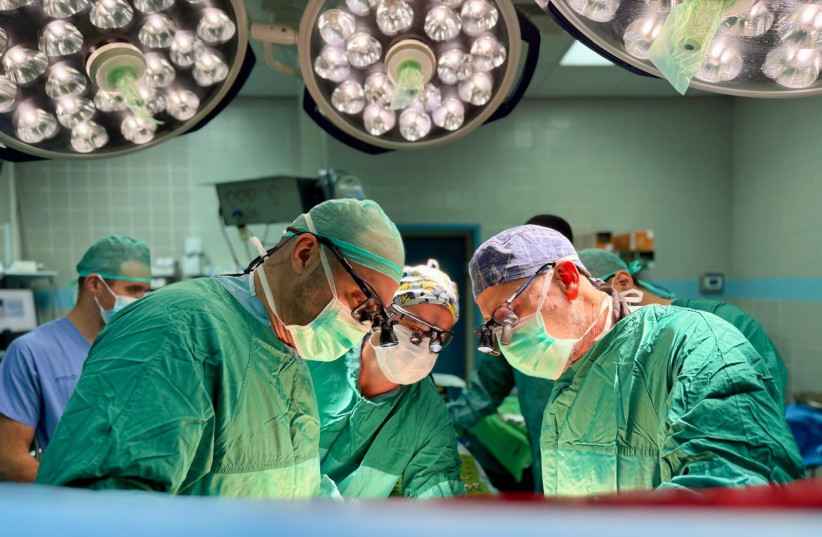
Now, doctors at the Rabin Medical Center-Beilinson branch (RMC) in Petah Tikva have performed a rare and complex intestinal transplant into his body. He still can’t eat, as it takes weeks for the organ to “take.” In the meantime, they are performing biopsies every few days to test if it’s working. Unlike after kidney or liver transplants, blood tests are not enough to determine if the organ is functioning normally.
He is now hospitalized at RMC’s general intensive care unit, where his condition is stable and he’s awake. If it’s finally declared successful, his stoma will be closed, and he will be able to live normally without medical devices or dietary restrictions. Thanks to the transplant, Biton hopes to pursue his dream – “to eat like everyone else and become a chef – and a father, too.”
Dreams of becoming a chef
Dr. Eviatar Nesher, head of the hospital’s transplantation department who performed the rare procedure, said: “Daniel is a true fighter. His resilience moved all of us.” Biton is a trained chef; from a young age, he worked alongside his father, who ran a bakery and culinary businesses. “From the age of eight, I worked with my dad baking pastries and preparing sandwiches for soldiers. His sister is a chocolatier. It was clear to me that I would be a chef. It’s in my blood,” he said. But when he was 19, shortly before his enlistment in the IDF, doctors discovered polyps and tumors in his intestines.
Throughout the years, Biton tried to pursue his dream, but his medical condition forced him to stop. “Working with fresh vegetables caused infections, and the doctors told me to choose: the dream or my health.” His work was very frustrating, as he was always surrounded by food, but he didn’t give up. “I just want to cook again, travel the world without medical devices, start having a family, open my own business, eat, and truly feel satiated.”
Nesher said: “This is one of the most complex and rare procedures and it requires precise coordination between many teams and very advanced surgical skills. Daniel, whom I have been accompanying for 17 years, is a true fighter. His strength has moved us all. Thanks to the organ donation from a noble family, he is expected to regain the ability to live, work, pursue his dreams, and rediscover the joy of life through taste.”
The transplant was made possible through organ donation, given by a Jerusalem family whose six-year-old son died from complications of influenza even though he had received a flu shot. The boy, generally healthy, suffered from fever and cough several days ago. In a rare and tragic event, his condition deteriorated and despite resuscitation efforts, he died.
The Health Ministry said that in Israel and other countries, this year’s flu season began early, and it is clear that the rate of flu morbidity is on a steep rise. From monitoring data worldwide, it is expected to be a season with severe illness from the flu. It stressed that although the flu vaccine does not completely prevent infection with the disease, in most cases it helps prevent infection or at least to reduce its severity, and the risk of serious illness or death.
Everyone from the age of six months and older should get a flu shot every year from their health fund.
Nesher worked on harvesting the organ (taking four hours) and transplanting it (seven hours) with Dr. Aviad Gravetz, Dr. Vladimir Tennak, and Dr. Fahim Kanani.
Nesher and his team previously performed intestinal transplants on two women in 2014 and 2018. There can always be complications, including infections and rejection. The first patient had to undergo a kidney transplant later. But both recipients are doing well, Nesher told The Jerusalem Post in an interview. He learned how to perform it in one of the largest transplantation medical centers in the world – at the Jackson Health System, part of the University of Miami Health System.
RMC runs Israel’s leading transplantation program, performing over 70% of the country’s organ transplants annually, including an active multiple-organ and living-related donor program.
“We have 150 patients who undergo TPN at home and manage. We have one other patient for an intestinal transplant, which is performed only if there is no other choice, such as no place on the abdomen to attach a stoma. We try to persuade them not to do it; some with stomas eat only for the feeling in their mouths, but it all exits quickly from the stoma,” Nesher noted.
According to the Intestinal Transplant Registry, between 1985 and 2023, there have been only about 5,000 of the procedures done around the world, the vast majority (about 100 yearly) in the US and some in the UK, Canada, India, China, and Saudi Arabia, among others.
The RMC department’s activities also include kidney, liver, heart, lung, and pancreas transplants; Nesher has been doing it since 2008. “It’s the most complicated surgery, but it’s like magic. Instead of removing organs, like with cancer, we put them in and people can be cured,” Nesher concluded. He hopes to perform uterine transplants in the future. In the long term, there will be printed organs for transplants and those taken from pigs; so far, those with transplants of porcine organs have ended in rejection.