
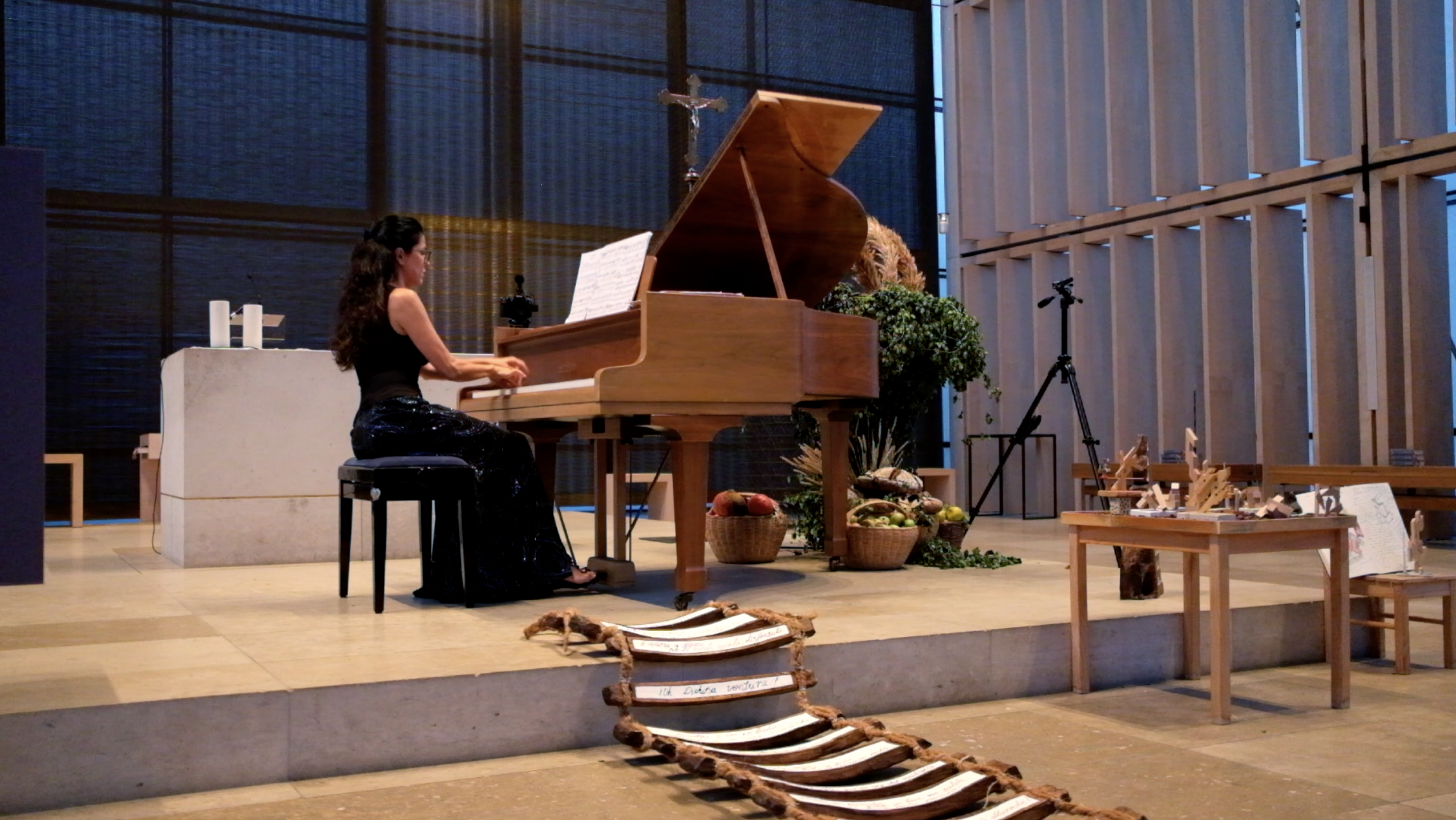
Since 2022, Azerbaijani pianist Ulviyya Abdullayeva and Spanish painter and sculptor Nani Boronat have been implementing a unique project titled "From Alhambra to Shirvanshah." It builds an aesthetic bridge between two cultures– Spanish and Azerbaijani – through art, spirituality, and anthropology. These worlds are symbolically represented by the Alhambra palaces in Granada and the Palace of the Shirvanshahs in Baku.
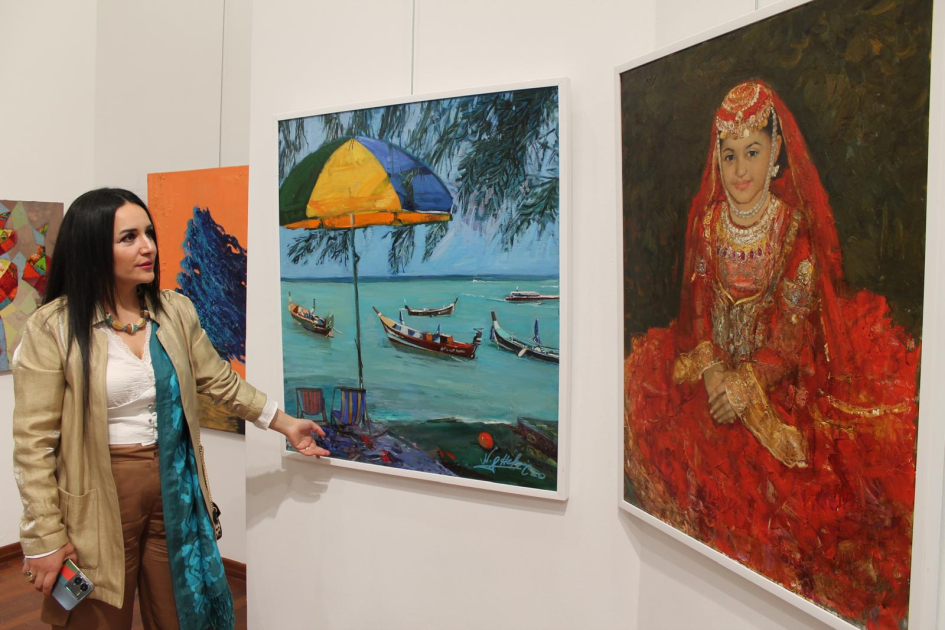
The result of the project is a concert-exhibition where a musical program performed by U. Abdullayeva unites Spanish and Azerbaijani traditions– from classical to jazz, including works by Falla, Albéniz, Granados, Gara Garayev, Fikret Amirov, and other composers. In the visual component, Nani Boronat creates "carpet-paintings" that can be rolled up and transported, just as they were during the time of the Silk Road.
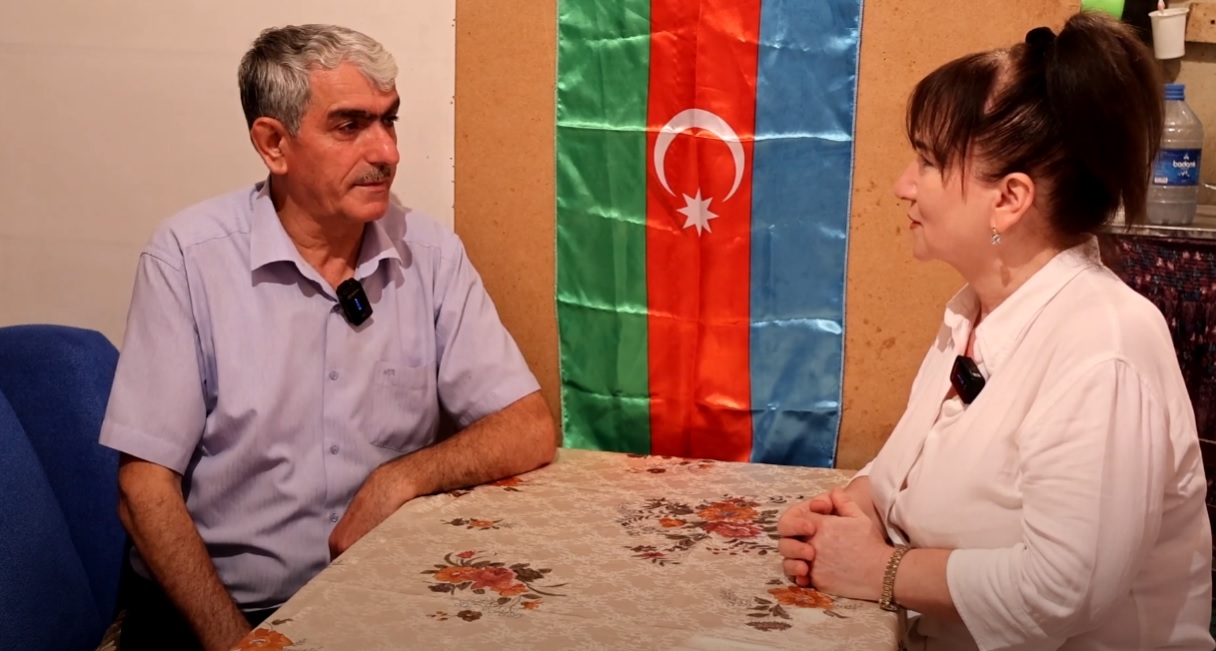
In a conversation with an AZERTAC correspondent, artist Nani Boronat shared how it all began.
– Nani, how did the idea for this project come about?
– Actually, it is an expansion of my previous project "Guards" (Centinelas), which began in 2017. That was a body of work combining painting and sculpture, but with an anthropological subtext, focusing on the image of the historical warrior as well as the weapon and shield as artistic objects– which, moreover, are predecessors to modern art.
In 2022, I met Ulviyya Abdullayeva. This coincided with a moment when "Guards" had reached a deadlock, and I didn't know which direction to take– I was experiencing a creative crisis. It was Ulviyya who gradually gave me new reasons to continue my research, introducing a culture new to me– Azerbaijani– and a new artistic genre– music. Thus, the project "From Alhambra to Shirvanshah" was born.
Ultimately, this is a collaborative effort between a painter/sculptor and a pianist. It is a kind of duo in which we exchange music and visual art on stage. It is a concert-exhibition where both languages maintain their independence; that is, it is not an exhibition with musical accompaniment, nor is it a concert with scenery. Our idea is to create a single whole.
Each of us has our own role. Ulviyya forms the program of musical pieces by both classical and contemporary authors–ranging from academic music to folklore, jazz, mugham, and flamenco– always including both Spanish and Azerbaijani composers. For my part, I create a series of works inspired by the Mudéjar art of my country and the Shirvan school of carpet weaving, which is so vital to Azerbaijani culture. I work primarily with symbols extracted from these two contexts, creating paintings without stretchers so they can be rolled up for transport – just as nomadic peoples transported carpets on animals.
I would like to express my gratitude, first and foremost, to the researcher Fuad Akhundov, who significantly enriched my knowledge of Azerbaijani culture during a tour of Icherisheher (the Old City). I also thank the creative director of "Azerkhalcha," Asmer Babayeva, thanks to whom I was able to obtain valuable informational, graphic, and symbolic material for my new works.
– While studying Azerbaijani culture, have you noticed similarities with the culture of Spain?
– There are far more than I had imagined. The more I learn about Azerbaijani culture, the more common ground I find with Spanish culture. I realized this the day I first attended a Mugham festival. Closing my eyes, it was as if I were in Córdoba, Málaga, or Granada, listening to Flamenco– specifically cante jondo (the oldest, most serious, and emotionally intense style of Andalusian Flamenco).
Europeans built their identity on a Greco-Roman foundation: Greek philosophy, Roman law, and Judeo-Christian morality. But we were mistaken in thinking the Mediterranean Sea was the boundary of our civilization. In reality, it stretches much further– from the Atlantic in the west to the Caucasus and Asia Minor in the east. Crossing the Bosphorus, the traveler discovers the Black Sea, and then, passing the Caucasus, a new, almost magical sea: the Khazar, that is, the Caspian. I see this as a unified cultural axis– a bridge from the shores of Portugal to Baku, which serves as a gateway to Asia.
We live on the same latitude, under similar climatic conditions, growing similar products– fruits and vegetables– and have therefore developed a similar gastronomic culture. Our peoples are also very family-oriented. Both the Iberian Peninsula and Azerbaijan have passed through the cultures of many peoples whose traditions shaped modern society.
One moment particularly reminded me of the Spain of my youth– the year 1978, when after 40 years of dictatorship, three generations began building the country together: the generation of grandfathers hardened by the Franco regime; the parents– young and energetic; and our generation– open to the world. I saw a similar picture in Azerbaijan: the older generation who lived through the Soviet era; their children– an energetic society building the future; and the youth– educated, hardworking, and culturally developed thanks to a strong educational system.
– Returning to the project "From Alhambra to Shirvanshah"– where and how has it been presented, and when is its next iteration planned?
– The most important thing about this project is that it develops naturally, without rigid deadlines or structures. We are constantly adding new works and musical pieces, and for each performance, we adapt the program to the space.
To date, the project has been presented twice in Munich, where we live: at the Haus des Deutschen Ostens (2022) and at the Herz Jesu Kirche (2023); and twice in Baku: at YARAT (2023) and the International Mugham Center (2023).
In Baku, my works were displayed in the format of an audiovisual installation via stage projections. However, we hope that in the future we can show a full-scale concert-exhibition in Azerbaijan with the original works brought from my studio in Germany. We are also preparing a future presentation of the project at the Spanish Embassy in Berlin.
Author: Anara Akhundova