
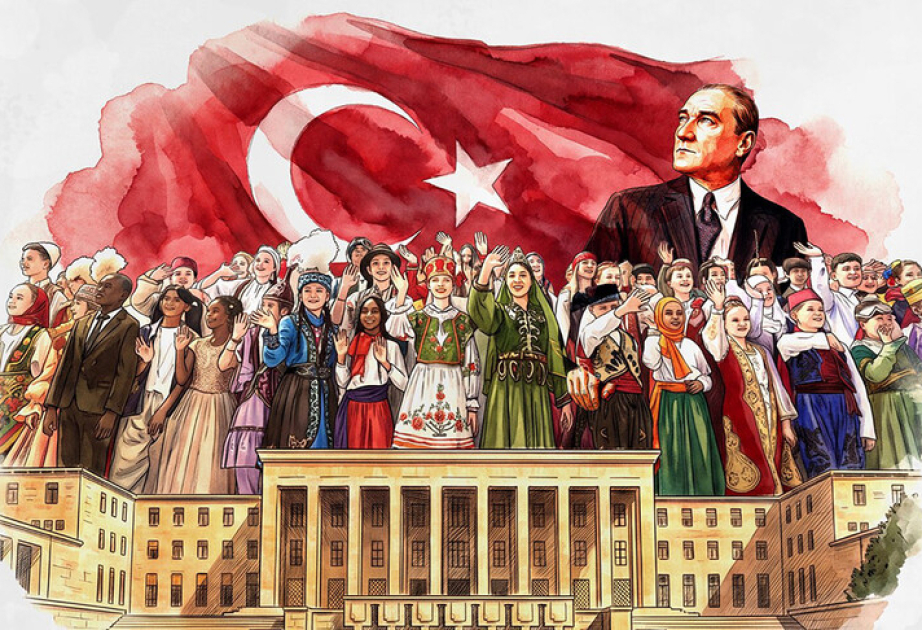
National Sovereignty and Children’s Day, observed on April 23, marks the first convening of the Turkish Grand National Assembly (TBMM) in 1920 during Türkiye’s War of Independence, according to Daily Sabah.
The law adopted in 1921 formally designated the date as a national holiday, recognizing it as a foundational moment of legislative sovereignty in the newly established state.
In 1929, Gazi Mustafa Kemal Atatürk dedicated the day to children, laying the foundation for what would later become Children’s Day.
This decision marked a historic shift, positioning children at the heart of national celebrations and reflecting the republic’s vision of the future generation as the guarantor of sovereignty.
Over time, the holiday underwent several legal and institutional revisions. In 1935, it was officially defined as “National Sovereignty Day” under the Law on National Holidays and General Holidays.
Later amendments in 1983 renamed it “National Sovereignty and Children’s Day,” reflecting its dual identity as both a political milestone and a celebration of childhood.
The transformation of April 23 into an international event began in 1979, when children from six countries were invited to Türkiye for the celebrations.
This initiative gradually expanded, turning the occasion into a global platform where children from different nations gather annually in Türkiye, symbolizing peace, friendship and cultural exchange.
According to archival documents preserved by the Turkish Grand National Assembly, the foundations of the day are deeply rooted in the early establishment of parliamentary governance.
Records highlight the opening ceremony led by Mustafa Kemal Atatürk, accompanied by nationwide prayers and celebrations, as well as his early emphasis on transferring authority to the will of the nation.
Today, April 23 stands as both a historical reference point and a living tradition. It continues to reflect the principles of national sovereignty while reinforcing Türkiye’s unique global role in dedicating a national holiday to children and sharing it with the world.
Each year, the day is marked across Türkiye through a wide range of nationwide events that place children at the center of public life, with activities organized in institutions, cities, and public spaces under different thematic programs.
On Tuesday, one of the key events was the “April 23 Children’s Forum” held at the TBMM, in cooperation with the Ministry of National Education. Hosted in the Parliament Conference Hall, the forum brought together children as part of the official celebrations.
Within the framework of the program, Parliament welcomed 52 children from 26 countries, reflecting the international dimension of this year’s celebrations.
The visiting delegation took part in official proceedings at Parliament, where they were received in the ceremonial hall and engaged directly with parliamentary leadership.
During the meeting, Parliament Speaker Numan Kurtulmuş addressed the students, highlighting that tens of thousands of children participate in April 23 activities hosted at Parliament each year.
He also pointed to global challenges affecting children, noting that millions are currently deprived of access to education and that nearly 49 million live in conflict zones, underscoring the importance of placing children at the center of both national and international policy discussions.
On Wednesday, cities across Türkiye will host a wide range of cultural and artistic programs designed to engage children across multiple venues.
Museums and cultural institutions in Istanbul will also open their doors to visitors, offering interactive workshops and educational activities throughout the day.