
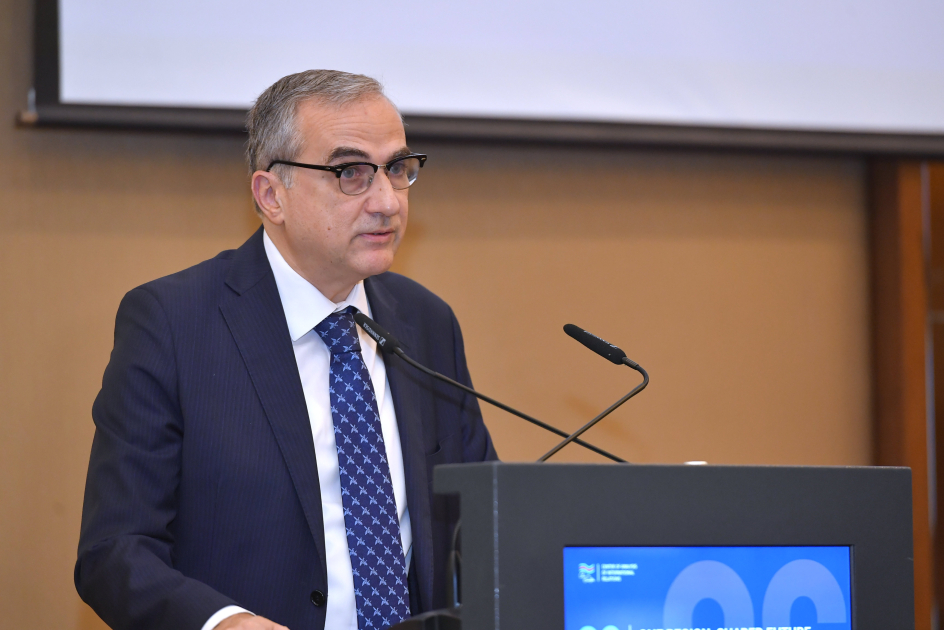
An international conference on “C6: One Region, Shared Future – Enhancing Strategic Dialogue,” organized by the Center for Analysis of International Relations (AIR Center) was held in Baku, on February 18.
The event gathered up to 60 participants, including members of the think tanks of the C6 format member states.
“Central Asia is a natural partner rather than just a neighbor. Despite our shared history and culture, geoeconomics-energy, transportation, logistics, and infrastructure-is what makes our partnership unique today. Since the conventional presumptions of stability in the larger Eurasian space are no longer valid, these connections have taken on new significance,” said Farid Shafiyev, AIR Center Chairman.
“Connectivity, diversification, and regional cooperation based on common interests are essential for strategic resilience. Over the past six years, Azerbaijan’s foreign policy has reflected this reality. By working with Asian institutions and extending its strategic alliances, Azerbaijan has fortified its eastern vector while continuing to engage constructively with the United States and its European partners,” he added.
“Azerbaijan's accession to the Consultative Meetings of Heads of State of Central Asia marks a new chapter in the history of regional cooperation, and this meeting represents an important step along this path. The C6 format is not merely a platform for dialogue, but a dynamic mechanism that enables us to find common solutions amid global instability, build sustainable economic ties based on mutual benefit, and strengthen trust through humanitarian cooperation and the exchange of experiences," noted Shiri Shiriyev, Director of the Center for Strategic Studies under the Institute of International Relations at the Ministry of Foreign Affairs of Turkmenistan.
According to him, the expert community plays a key role in fostering regional cooperation and dialogue through the C6 format.
“Analysts, researchers, and think tank representatives help transform ideas into concrete mechanisms of cooperation, enabling us to anticipate risks while seizing emerging opportunities. Moreover, active collaboration among experts from different countries contributes to the development of a unified agenda that reflects the interests of all parties," he added.
The event proceeded with panel discussions.