
POLITICS
China’s CGTN TV channel broadcast AZERTAC's report on Middle Corridor
The Global South Voices project by CGTN (China Global Television Network) is a media initiative designed to amplify the perspectives of Global South countries. It provides a platform for the critical issues impacting these countries.
CGTN broadcast an extensive reportage on the Middle Corridor by AZERTAC news agency, who is one of the project's partners on the Middle Corridor.
AZERTAC presents the report:
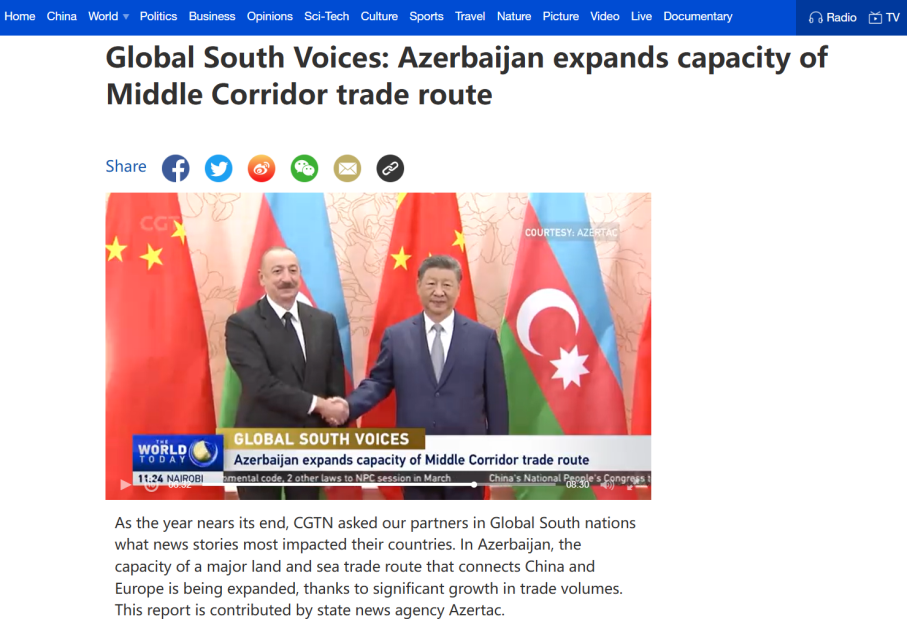
“As the year nears its end, CGTN asked our partners in Global South nations what news stories most impacted their countries. In Azerbaijan, the capacity of a major land and sea trade route that connects China and Europe is being expanded, thanks to significant growth in trade volumes.
The Middle Corridor, also known as the Trans-Caspian International Transport Route, is a major land and sea logistics route linking China and Southeast Asia with Europe via Kazakhstan, the Caspian Sea, Azerbaijan, Georgia, and Türkiye. The Middle Corridor is a strategic project spanning a wide geographical area.”
“The corridor serves as the most efficient, safe, and shortest route for the delivery of cargo from China to Europe and back.
The Middle Corridor was established with the participation of the relevant structures of Azerbaijan, Kazakhstan, and Georgia in February 2014. Later, other countries also joined the project. Currently, the route originates at the China–Kazakhstan border and extends all the way to Europe.
The instability caused by the outbreak of the Russia–Ukraine war on February 24, 2022, disrupted traditional transport routes passing through Russian territory. European sanctions against Russia further limited the opportunities offered by transit routes. Due to disruptions and problems along the Northern Corridor, the Middle Corridor, passing through Azerbaijan, became a vital artery as Eurasian countries and businesses sought alternative trade routes. In recent years, the Middle Corridor has gained importance as a convenient trade route between the People's Republic of China and Europe. It should be noted that the Middle Corridor, the main alternative to the Northern Corridor, enables transportation from China to Europe in 12 days, covering 7,000 kilometers instead of 10,000 kilometers.
In 2024, the volume of cargo transported along the Trans-Caspian International Transport Route increased by 62 percent compared to the previous year, reaching 4.5 million tons. Transit flows registered a particularly significant increase: total transit volume increased fourfold, while transit from China grew more than 25 times.
In the first ten months of 2025, a total of 292 container trains departed from China along the Trans-Caspian International Transport Route, a 12 percent increase compared to the same period last year.
According to forecasts by the World Bank, the European Bank for Reconstruction and Development, and the Organisation for Economic Co-operation and Development, by 2030 the volume of shipments along the Middle Corridor will reach 11 million tons, and by 2040 container capacity will rise to 865,000 TEUs.
For Azerbaijan, this is not just a temporary alternative or a backup plan, but a long-term and sustainable route for global trade. In recent years, Azerbaijan has extensively developed the potential of the Middle Corridor, making significant investments in its infrastructure and transforming it into a modern, efficient, and sustainable transport link.
Perched on the historic Silk Road connecting Europe and Asia, the Port of Baku serves as a key hub in the Eurasian transport and logistics network, offering efficient cargo services and extensive storage facilities for a variety of cargo types. With the completion of its initial phase in 2018, the port's capacity increased to handle 15 million tons of cargo and 100,000 TEU equivalent containers. A second phase is under development, which could increase the port's annual capacity to 25 million tons and 500,000 TEU containers.
Currently, the construction of a new cargo airport is underway in the Alat Free Economic Zone. The project will significantly bolster trade logistics and promote economic development along the entire Middle Corridor. By strengthening Azerbaijan's transport infrastructure, it will further boost the country's potential as a strategic transit hub and consolidate its role as a key player connecting Europe and Asia through efficient and modern trade routes.
In general, to meet growing demand and enhance the functionality of the corridor, significant projects are underway on both soft and hard infrastructure to increase efficiency and effectiveness. To fully unlock the potential of the transit corridors at the national level, extensive monitoring is in place to study business processes along the route, identify key weaknesses, and seize opportunities. Continuous modernization of infrastructure, expansion of international partnerships, and sustainable improvement of Azerbaijan's connectivity are key components of the country's long-term economic strategy.
In parallel with these efforts, Azerbaijan is also heavily involved in initiatives to transform the Middle Corridor into a green corridor, prioritizing sustainable and environmentally friendly practices in transport and logistics.
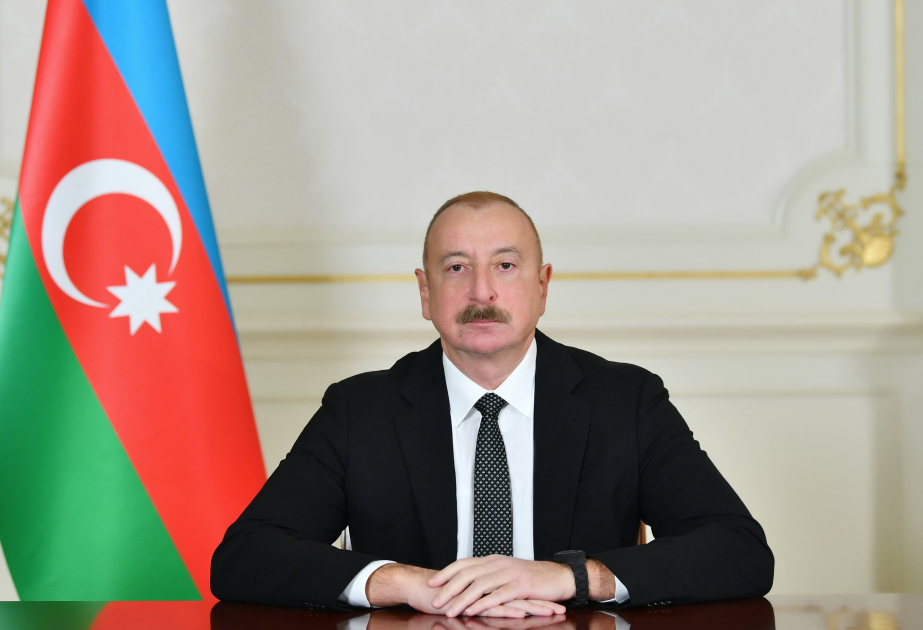
On August 31 of this year, during a meeting with President Ilham Aliyev in Tianjin, China, Chinese President Xi Jinping noted that cooperation between Azerbaijan and China has strengthened within the framework of the Belt and Road Initiative, highlighting the importance of transporting Chinese goods through Azerbaijani territory and emphasizing the significance of the Trans-Caspian route.
During the meeting, President Ilham Aliyev also touched upon the Belt and Road Initiative, noting that the increase in shipments, particularly of Chinese cargo, via the Middle Corridor passing through Azerbaijan, an essential component of the initiative, serves as an example of the corridor's efficiency and attractiveness.
The Joint Statement on the Establishment of a Comprehensive Strategic Partnership between Azerbaijan and China, as well as the Memorandum of Understanding signed by the Azerbaijani and Chinese governments for the China–Europe Railway Express, has significantly contributed to the development of the corridor. As a result, over 350 block trains were sent from China along the Middle Corridor last year, with an average transit time of 10 days to Azerbaijani ports and 12 days to Georgian ports.
Azerbaijan aims to further diversify the Middle Corridor by implementing the Zangezur Corridor project. This project will restore the historical connection between the western regions of Azerbaijan and the Nakhchivan Autonomous Republic. This will significantly reduce the covered distance, increase annual throughput capacity, and shorten transit times
More importantly, Azerbaijan will enhance regional connectivity and create substantial opportunities for the development of the transport and logistics sector as a vital part of the Middle Corridor.